AI/ML & Data Science / PricePilot-Intelligent-Pricing-Dashboard
PricePilot: AI-Powered Pricing Optimization Tool
PricePilot is a comprehensive pricing optimization platform that use current machine learning algorithms to help businesses make data-driven pricing decisions.
Open the full technical write-up




Revolutionary AI-powered pricing optimization platform that combines advanced machine learning algorithms with intuitive user experience to maximize profitability and market competitiveness.
Quick Start • Features • Business Logic • ML Models • Installation • Documentation
 PricePilot Dashboard - AI-Powered Pricing Optimization Interface
What this project does
PricePilot is a comprehensive pricing optimization platform that use current machine learning algorithms to help businesses make data-driven pricing decisions. The platform combines multiple AI models to analyze market conditions, predict demand, optimize pricing strategies, and provide actionable insights for maximizing profitability.
What the system can do
- ** Multi-Algorithm Optimization**: Combines multiple ML models for reliable pricing recommendations
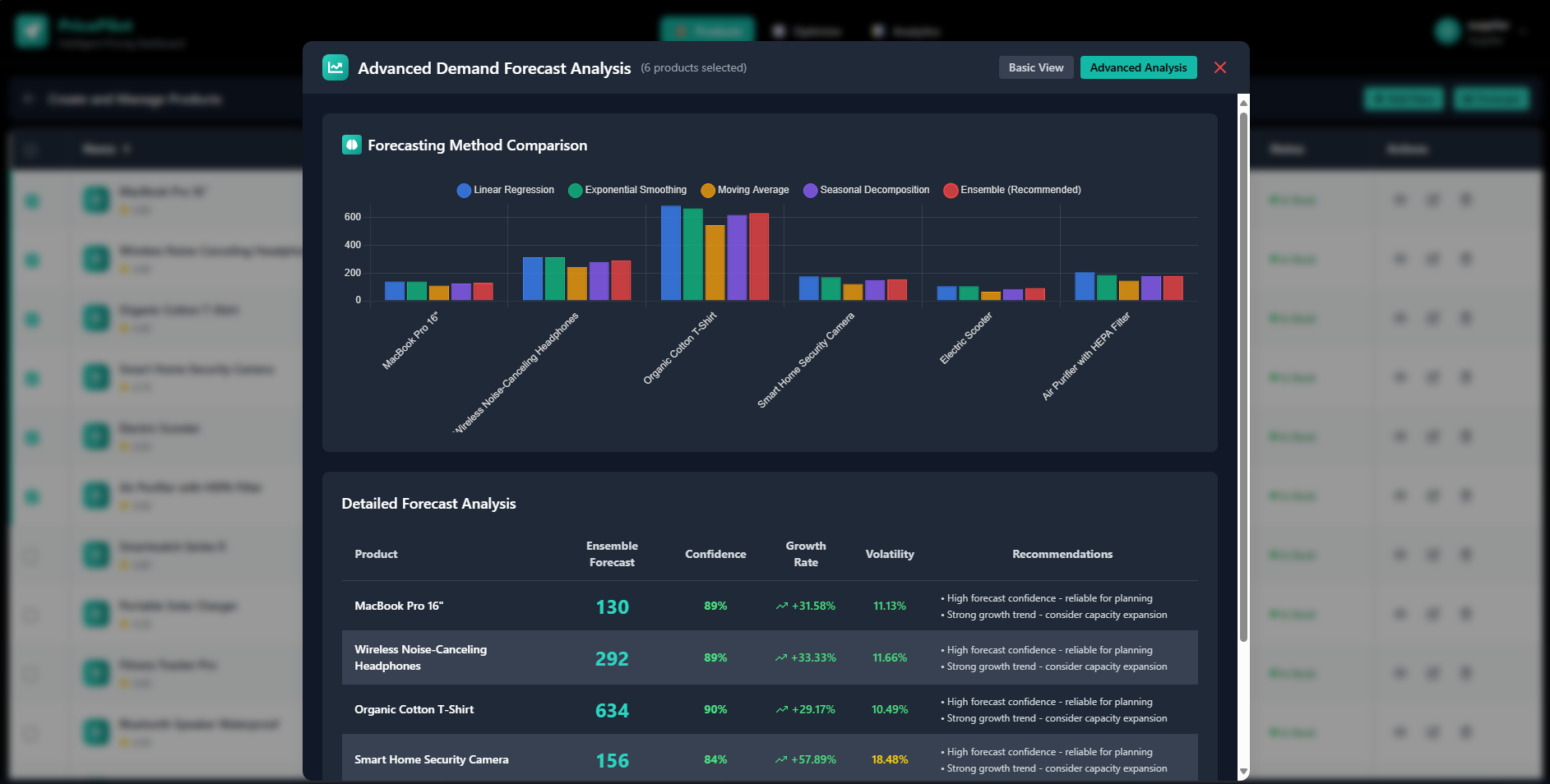
- ** Advanced Demand Forecasting**: Predicts future demand using ensemble forecasting methods
- ** Price Elasticity Analysis**: Analyzes price sensitivity across product categories
- ** A/B Testing Simulation**: Simulates different pricing strategies and their outcomes
- ** Inventory-Aware Pricing**: Considers stock levels in pricing decisions
- ** Transparent Justification**: Provides clear explanations for all recommendations
How the project works
The problem this project addresses
In today's competitive market, businesses face critical pricing challenges:
- Price Wars: Competing solely on price erodes margins
- Market Volatility: Rapid changes in demand, costs, and competition
- Inventory Mismatch: Over/under-stocking due to poor demand prediction
- Customer Sensitivity: Different customer segments respond differently to price changes
- Seasonal Fluctuations: Demand patterns vary significantly across time periods
PricePilot's Business Solution
PricePilot addresses these challenges through a sophisticated, multi-layered approach:
1. Dynamic Pricing Strategy Framework
Business Logic: Instead of static pricing, PricePilot implements dynamic pricing that adapts to:
- Market Conditions: Real-time competitor analysis and market trends
- Demand Patterns: Seasonal, weekly, and daily demand fluctuations
- Inventory Levels: Stock-aware pricing to optimize turnover
- Customer Segments: Different pricing strategies for different customer types
Implementation:
# Dynamic pricing considers multiple factors
optimal_price = base_price * market_factor * demand_factor * inventory_factor * segment_factor
2. Profit Maximization vs. Revenue Maximization
Business Logic: PricePilot focuses on profit maximization rather than just revenue maximization:
- Revenue Maximization: Often leads to lower prices, higher volume, but reduced margins
- Profit Maximization: Balances price, volume, and costs for optimal profitability
Mathematical Foundation:
Profit = (Price - Cost) × Quantity
Optimal Price = Cost + (Cost / |Elasticity|)
3. Price Elasticity-Driven Decisions
Business Logic: Understanding how customers respond to price changes is crucial:
- Elastic Products (|ε| > 1): Price decreases increase revenue
- Inelastic Products (|ε| int: years = np.array([int(year) for year in historical_years.keys()]) values = np.array([historical_years[year] for year in historical_years.keys()]) slope, intercept = np.polyfit(years, values, 1) next_year = years.max() + 1 forecast = intercept + slope * next_year
**Use Case**: Best for products with consistent linear growth trends

#### 2.2 Exponential Smoothing Forecast
```python
def exponential_smoothing_forecast(self, historical_years: Dict, alpha: float = 0.3) -> int:
    # Holt's method with trend adjustment
    s = [values[0]]  # Level
    b = [values[1] - values[0]]  # Trend

    for i in range(1, len(values)):
        s_new = alpha * values[i] + (1 - alpha) * (s[i-1] + b[i-1])
        b_new = 0.2 * (s_new - s[i-1]) + 0.8 * b[i-1]
        s.append(s_new)
        b.append(b_new)

    forecast = s[-1] + b[-1]
Use Case: Ideal for products with trend and seasonal patterns
2.3 Moving Average Forecast
def moving_average_forecast(self, historical_years: Dict, window: int = 3) -> int:
    # Calculate moving average with trend projection
    ma_values = []
    for i in range(window - 1, len(values)):
        ma_values.append(np.mean(values[i-window+1:i+1]))

    ma_trend = (ma_values[-1] - ma_values[0]) / len(ma_values)
    forecast = ma_values[-1] + ma_trend
Use Case: Effective for smoothing out random fluctuations
2.4 Seasonal Decomposition Forecast
def seasonal_decomposition_forecast(self, historical_years: Dict) -> int:
    # Decompose into trend + seasonal + residual components
    x = np.arange(len(values))
    slope, intercept = np.polyfit(x, values, 1)
    trend = [intercept + slope * i for i in x]

    detrended = [values[i] - trend[i] for i in range(len(values))]
    seasonal = np.mean(detrended)

    next_trend = intercept + slope * len(values)
    forecast = next_trend + seasonal
Use Case: Perfect for products with strong seasonal patterns
2.5 Ensemble Forecast
def ensemble_forecast(self, historical_years: Dict) -> Dict[str, int]:
    forecasts = {
        'linear': self.simple_linear_forecast(historical_years),
        'exponential': self.exponential_smoothing_forecast(historical_years),
        'moving_average': self.moving_average_forecast(historical_years),
        'seasonal': self.seasonal_decomposition_forecast(historical_years)
    }

    # Weighted ensemble
    weights = {'linear': 0.25, 'exponential': 0.35, 'moving_average': 0.25, 'seasonal': 0.15}
    ensemble_forecast = sum(forecasts[method] * weights[method] for method in forecasts)
Advantages:
- Robustness: Combines multiple methods to reduce individual model errors
- Adaptability: Different weights for different forecasting scenarios
- Confidence Scoring: Calculates confidence based on model agreement
3. Advanced Price Optimization (advanced_optimization.py)
Algorithm Type: Multi-Factor Machine Learning Optimization
3.1 Price Elasticity Analyzer
class PriceElasticityAnalyzer:
    def calculate_elasticity(self, price_history: List[float], demand_history: List[float]) -> float:
        # Log-log regression for elasticity calculation
        log_prices = np.log(price_history)
        log_demands = np.log(demand_history)

        model = LinearRegression()
        model.fit(log_prices.reshape(-1, 1), log_demands)
        elasticity = model.coef_[0]
Features:
- Category-Specific Elasticity: Different elasticity values for different product categories
- Heatmap Generation: Visual representation of elasticity across categories
- Insight Generation: Automated insights based on elasticity values
3.2 ML Price Optimizer
class MLPriceOptimizer:
    def extract_features(self, product: Dict) -> np.ndarray:
        features = [
            float(product.get('cost_price', 0)),
            float(product.get('selling_price', 0)),
            float(product.get('stock_available', 0)),
            float(product.get('units_sold', 0)),
            float(product.get('customer_rating', 0)),
            hash(str(product.get('category', ''))) % 1000,  # Category encoding
            float(product.get('demand_forecast_value', 0))
        ]
        return np.array(features).reshape(1, -1)
ML Model: Random Forest Regressor (with fallback implementation)
- Features: Cost price, selling price, stock levels, sales history, customer ratings, category, demand forecast
- Target: Optimal price ratio (selling_price / cost_price)
- Training: Uses historical product data to learn optimal pricing patterns
3.3 Inventory-Aware Optimizer
class InventoryAwareOptimizer:
    def adjust_price_for_inventory(self, base_price: float, inventory_status: str,
                                 current_demand: float, elasticity: float) -> float:
        adjustments = {
            'low': 1.15,      # Increase price by 15% when stock is low
            'medium': 1.05,   # Increase price by 5% when stock is medium
            'adequate': 1.0,  # No adjustment
            'high': 0.95,     # Decrease price by 5% when stock is high
        }

        adjustment_factor = adjustments.get(inventory_status, 1.0)
        return base_price * adjustment_factor
Logic:
- Low Stock: Increase prices to maximize revenue from limited inventory
- High Stock: Decrease prices to stimulate demand and reduce holding costs
- Dynamic Adjustment: Real-time price adjustments based on inventory levels
3.4 A/B Testing Simulator
class ABTestingSimulator:
    def simulate_strategy(self, product: Dict, strategy_name: str,
                         elasticity: float = -1.5) -> Dict[str, Any]:
        strategies = {
            'penetration': {'price_factor': 0.9, 'description': 'Low price to gain market share'},
            'skimming': {'price_factor': 1.3, 'description': 'High price for premium positioning'},
            'competitive': {'price_factor': 1.0, 'description': 'Match competitor pricing'},
            'cost_plus': {'price_factor': 1.2, 'description': 'Cost plus 20% margin'},
            'value_based': {'price_factor': 1.1, 'description': 'Price based on perceived value'}
        }
Simulation Capabilities:
- Multiple Strategies: Tests 5 different pricing strategies
- Outcome Prediction: Estimates revenue, profit, and demand for each strategy
- Comparative Analysis: Ranks strategies by profitability
- Risk Assessment: Evaluates trade-offs between different approaches
3.5 Justification Engine
class JustificationEngine:
    def generate_justification(self, product: Dict, recommended_price: float,
                             factors_used: List[str]) -> Dict[str, Any]:
        justification = {
            'recommended_price': round(recommended_price, 2),
            'current_price': round(current_price, 2),
            'price_change_percent': round(price_change, 1),
            'factors': [],
            'summary': '',
            'confidence': 0.85
        }
Transparency Features:
- Factor Analysis: Explains which factors influenced the recommendation
- Impact Assessment: Quantifies the impact of each factor
- Human-Readable Summary: Provides clear, actionable explanations
- Confidence Scoring: Indicates the reliability of recommendations
4. Model Integration and Ensemble Approach
The PricePilot system uses a sophisticated ensemble approach that combines multiple models:
def advanced_optimize_price(product: Dict) -> Dict[str, Any]:
    # Initialize all components
    elasticity_analyzer = PriceElasticityAnalyzer()
    ml_optimizer = MLPriceOptimizer()
    inventory_optimizer = InventoryAwareOptimizer()
    ab_simulator = ABTestingSimulator()
    justification_engine = JustificationEngine()

    # Multi-stage optimization
    ml_price, ml_confidence = ml_optimizer.predict_optimal_price(product)
    inventory_adjusted_price = inventory_optimizer.adjust_price_for_inventory(
        ml_price, inventory_status, demand_forecast, elasticity
    )

    # Generate comprehensive results
    ab_results = ab_simulator.compare_strategies(product, elasticity)
    justification = justification_engine.generate_justification(
        product, recommended_price, factors_used
    )
Ensemble Benefits:
- Reduced Overfitting: Multiple models reduce the risk of overfitting to specific patterns
- Improved Accuracy: Combines strengths of different algorithms
- Robustness: System continues to work even if individual models fail
- Comprehensive Insights: Provides multiple perspectives on pricing decisions
Quick Start
Prerequisites
- Python 3.8+
- Node.js 16+
- Git
Installation
-
Clone the repository
git clone https://github.com/Tuhin-SnapD/PricePilot-Intelligent-Pricing-Dashboard cd price-optimiser-tool -
Install dependencies
# Install backend dependencies cd price-optimiser-backend python -m venv venv source venv/bin/activate # On Windows: venv\Scripts\activate pip install -r requirements.txt # Install frontend dependencies cd ../price-optimiser-frontend npm install -
Run the application
# Start backend (from price-optimiser-backend directory) python manage.py runserver # Start frontend (from price-optimiser-frontend directory) npm start -
Access the application
- Frontend: http://localhost:3000
- Backend API: http://localhost:8000
Quick Test
python comprehensive_test_suite.py
What the project includes
Core workflows
- ** AI-Powered Pricing**: Advanced ML algorithms for optimal pricing
- ** Demand Forecasting**: Multi-algorithm ensemble forecasting
- ** Price Optimization**: Mathematical optimization with elasticity modeling
- ** Analytics Dashboard**: Comprehensive insights and visualizations
- ** A/B Testing**: Simulate different pricing strategies
- ** Inventory Management**: Stock-aware pricing recommendations
- ** User Management**: Role-based access control
- ** Responsive UI**: Modern, intuitive interface
Advanced workflows
- ** Elasticity Heatmap**: Visual price sensitivity analysis
- ** ML Optimization**: Machine learning-based price recommendations
- ** Performance Metrics**: Real-time optimization success tracking
- ** Transparent Justification**: Clear explanations for all recommendations
- ** Trend Analysis**: Historical performance tracking
- ** Auto-Save**: Automatic form saving and validation
- ** Data Export**: CSV export functionality
- ** Secure Authentication**: Token-based authentication
How the system is built
Backend (Django + Python)
price-optimiser-backend/
├── products/
│   ├── optimization.py          # Core price optimization algorithm
│   ├── forecasts.py             # Demand forecasting models
│   ├── advanced_optimization.py # Advanced ML optimization
│   ├── models.py               # Database models
│   └── views.py                # API endpoints
├── users/
│   ├── models.py               # User management
│   └── views.py                # Authentication
└── pricing_tool/
    └── settings.py             # Django configuration
Frontend (React + TypeScript)
price-optimiser-frontend/
├── src/
│   ├── components/
│   │   ├── analytics/          # Analytics dashboard components
│   │   ├── optimization/       # Pricing optimization UI
│   │   ├── products/          # Product management
│   │   └── common/            # Shared components
│   ├── contexts/              # React contexts
│   └── api.js                 # API integration
└── package.json
Documentation
API Documentation
- Products API:
/api/products/ - Users API:
/api/users/ - Optimization API:
/api/products/optimize/ - Forecasting API:
/api/products/forecast/
Machine Learning Models
- Price Optimization: Mathematical optimization with elasticity modeling
- Demand Forecasting: Ensemble time series forecasting
- ML Price Optimizer: Random Forest-based price prediction
- A/B Testing: Strategy simulation and comparison
Testing
Comprehensive Test Suite
# Run all tests
python comprehensive_test_suite.py

# Run specific test categories
python comprehensive_test_suite.py --api-only
python comprehensive_test_suite.py --frontend-only
python comprehensive_test_suite.py --ml-only
Test Coverage
- Backend API testing
- Frontend functionality testing
- Machine learning model validation
- User authentication testing
- Database connectivity testing
- System integration testing
Contributing
We welcome contributions! Please see our Contributing Guidelines for details.
Development Setup
- Fork the repository
- Create a feature branch
- Make your changes
- Add tests for new functionality
- Submit a pull request
License
This project is licensed under the MIT License - see the LICENSE file for details.
Acknowledgments
- NumPy: For efficient numerical computations
- Django: For reliable backend framework
- React: For modern frontend development
- Tailwind CSS: For beautiful, responsive UI
- Machine Learning Community: For inspiration and algorithms
Support
- Documentation: GitHub Wiki
- Issues: GitHub Issues
Made by Tuhin-SnapD